
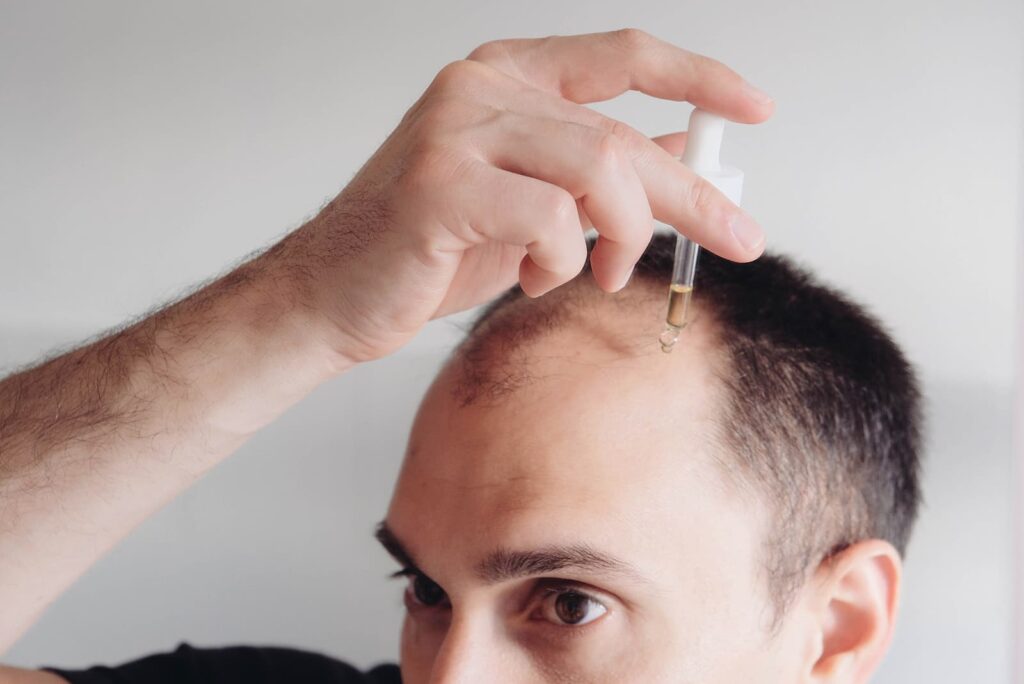
Male pattern baldness often runs in families, but that does not mean that a man will definitely lose his hair simply because his father or grandfather did. Genetics play a major role, but male pattern baldness is influenced by multiple genes, hormones and other factors.
If several men in your family have experienced a receding hairline or thinning crown, what does that actually mean for your own hair?
Is male pattern baldness genetic?
Yes: male pattern baldness, also known as androgenetic alopecia, has a strong genetic component.
Rather than being caused by a single ‘baldness gene’, however, it appears to involve several different genetic variations. These can influence how your hair follicles respond to hormones, particularly dihydrotestosterone (DHT), a hormone derived from testosterone.
This is why hair loss patterns can vary considerably between members of the same family. One man might start losing his hair in his twenties, while another may retain a full head of hair well into later life.
Does male pattern baldness come from your mother’s side?
There is a common belief that male pattern baldness is inherited exclusively from your mother’s side of the family. This comes from the fact that one important androgen receptor gene is located on the X chromosome, which men inherit from their mothers.
However, this is an oversimplification. Male pattern baldness is influenced by genes located on multiple chromosomes, meaning that both sides of your family can contribute to your likelihood of developing it.
Looking at your father’s hairline alone, or your maternal grandfather’s hair, therefore cannot reliably predict what will happen to your own hair. Your family history can provide clues, but it is not a precise forecast.
How does DHT cause male pattern baldness?
Genetics can affect how sensitive individual hair follicles are to DHT. In men who are genetically susceptible to male pattern baldness, DHT can cause certain follicles to gradually become smaller. This process is known as miniaturisation.
Over time, affected hairs may become finer and shorter, while the growth phase of the hair cycle becomes shorter. Eventually, some follicles may produce very little visible hair.
This tends to happen in characteristic areas, such as the temples, hairline and crown, which is why male pattern baldness often follows recognisable patterns.
When does genetic hair loss usually start?
There is no single age when male pattern baldness begins. Some men notice changes in their late teens or twenties, while others do not experience significant thinning until their thirties, forties or later.
Generally, the earlier male pattern baldness begins, the more noticeable it may become over time. However, the speed and extent of hair loss can vary substantially from one person to another.
If you have noticed increased shedding, a receding hairline or a thinning crown, it does not necessarily mean that you are destined to become bald.
There are also other possible causes of hair loss, including stress, illness, nutritional deficiencies and certain medical conditions.
Can you prevent genetic hair loss?
You cannot change your genes, but treatments can help some men manage male pattern baldness. For example, finasteride (the cheap generic version of Propecia) is one treatment used for male pattern hair loss.
It works by reducing the conversion of testosterone into DHT, thereby lowering DHT levels in the body. For men whose hair follicles are sensitive to DHT, this can help slow further hair loss and, in some cases, support hair regrowth.
Minoxidil is another established treatment for male pattern hair loss. It works differently from finasteride and may also be used as part of a hair-loss treatment plan.
Neither treatment is suitable for everyone, so it is important to seek appropriate medical advice before starting treatment.
What if baldness runs in your family?
A family history of male pattern baldness can increase your likelihood of developing it, but it does not tell you exactly when hair loss will begin or how extensive it will become.
If you are concerned about your hair, paying attention to gradual changes can be useful. A receding hairline, widening parting, increased visibility of the scalp or a thinning crown may be worth discussing with a healthcare professional.
Genetic hair loss is not necessarily something you simply have to accept without exploring your options. Understanding why it happens and recognising the signs early can help you make informed decisions about whether treatment is appropriate for you.