
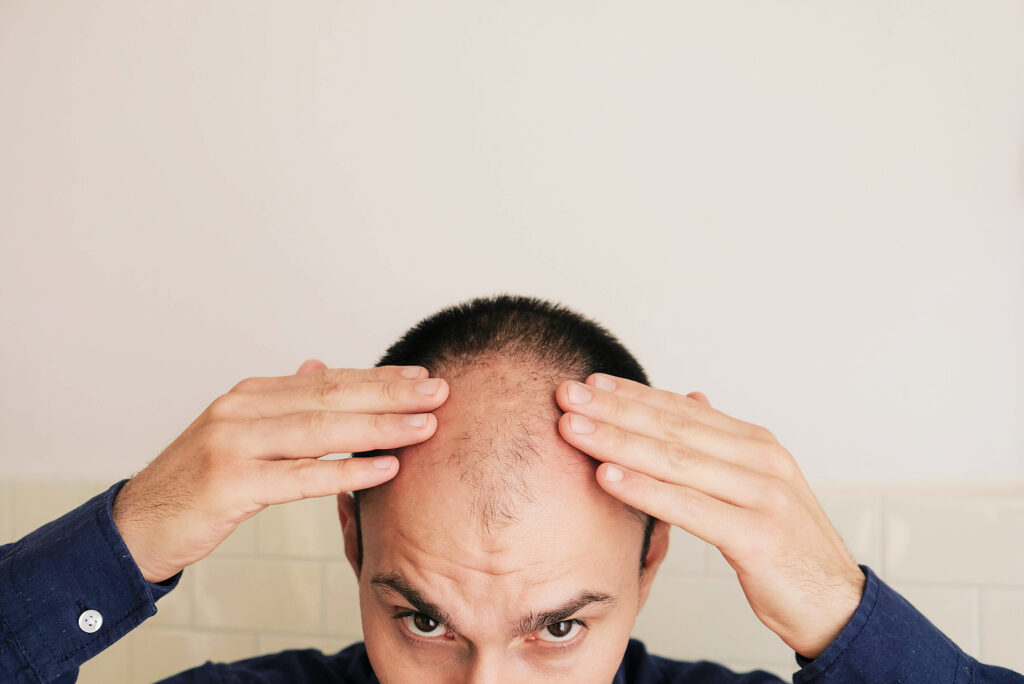
If you’re dealing with thinning hair or a receding hairline, you’ve probably come across the term ‘DHT.’ It’s often mentioned as the main cause of male pattern baldness, but what exactly is it, and why does it affect some men more than others?
Understanding DHT is crucial to understanding hair loss itself. Once you know how it works, the logic behind treatments such as finasteride becomes much clearer.
What is DHT?
DHT stands for dihydrotestosterone. It’s a hormone derived from testosterone, the primary male sex hormone. In the body, an enzyme called 5-alpha-reductase converts testosterone into DHT.
While DHT plays an important role during puberty, contributing to male characteristics like facial hair and a deeper voice, its role in adulthood is less beneficial, particularly when it comes to hair.
Why does DHT cause hair loss?
DHT isn’t a problem for everyone. The driving factor is genetic sensitivity. If you’re genetically predisposed to male pattern baldness, your hair follicles, especially those around the temples and crown, are more sensitive to DHT.
Over time, this sensitivity leads to a process called miniaturisation:
- Hair follicles gradually shrink
- Hair grows back finer and weaker
- Growth cycles become shorter
- Eventually, follicles stop producing visible hair altogether
This is why hair loss tends to follow a predictable pattern, rather than happening evenly across the scalp.
Why do some men lose hair and others don’t?
It comes down to genetics, not just hormone levels.
Two men can have similar DHT levels, but very different outcomes:
- One keeps a full head of hair
- The other experiences gradual thinning
The difference lies in how their hair follicles respond to DHT. If your follicles are sensitive, even normal levels of DHT can trigger hair loss. That’s also why male pattern baldness often runs in families.
Can you reduce DHT naturally?
There’s a lot of content online about ‘natural DHT blockers,’ but it’s important to approach this realistically.
Lifestyle factors such as diet, stress management, and overall health can support hair quality, but they don’t significantly reduce DHT levels in a way that stops genetic hair loss.
That doesn’t mean they’re not useful, because they can improve the condition of your hair and scalp, but they won’t address the root hormonal cause on their own.
How finasteride works against DHT
Finasteride is designed specifically to target DHT by blocking the 5-alpha-reductase enzyme responsible for converting testosterone into DHT.
As a result:
- DHT levels in the scalp are significantly reduced
- Hair follicles are protected from further shrinkage
- Hair loss slows, stops, or even partially reverses in some cases
This targeted approach is why finasteride is considered one of the most effective treatments for male pattern baldness.
Does reducing DHT affect the rest of your body?
This is a common concern, and it’s worth addressing clearly. While finasteride lowers DHT levels, it doesn’t eliminate the hormone completely. It also doesn’t switch off testosterone.
For most men:
- Hormone levels remain within normal ranges
- The body continues to function as expected
- The primary effect is localised to hair follicles and the scalp
As with any medication, individual responses can vary, but finasteride has been widely studied and used for decades.
When should you act on hair loss?
Timing matters, because DHT gradually shrinks hair follicles over time, so waiting too long can make treatment less effective. Once a follicle becomes inactive, it may not recover.
Early signs to look out for include:
- A receding hairline
- Thinning at the crown
- More hair shedding than usual
- A noticeable change in hair thickness
Starting treatment early gives you the best chance of maintaining what you already have.
The role of cost-effective hair loss treatment options
One barrier that stops many men from acting is cost, especially when treatment needs to be ongoing. This is where generic, cheaper finasteride can make a difference.
Generic versions contain the same active ingredient as branded alternatives, meaning:
- They work in the same way
- They meet the same safety and quality standards
- They offer a more affordable long-term solution
Choosing a trusted, regulated UK provider allows you to access treatment confidently, without overpaying for branding.
DHT is the driving force behind male pattern baldness, but it’s only part of the story. Genetics determine how your hair follicles respond, and that’s what ultimately shapes your hair loss pattern.