
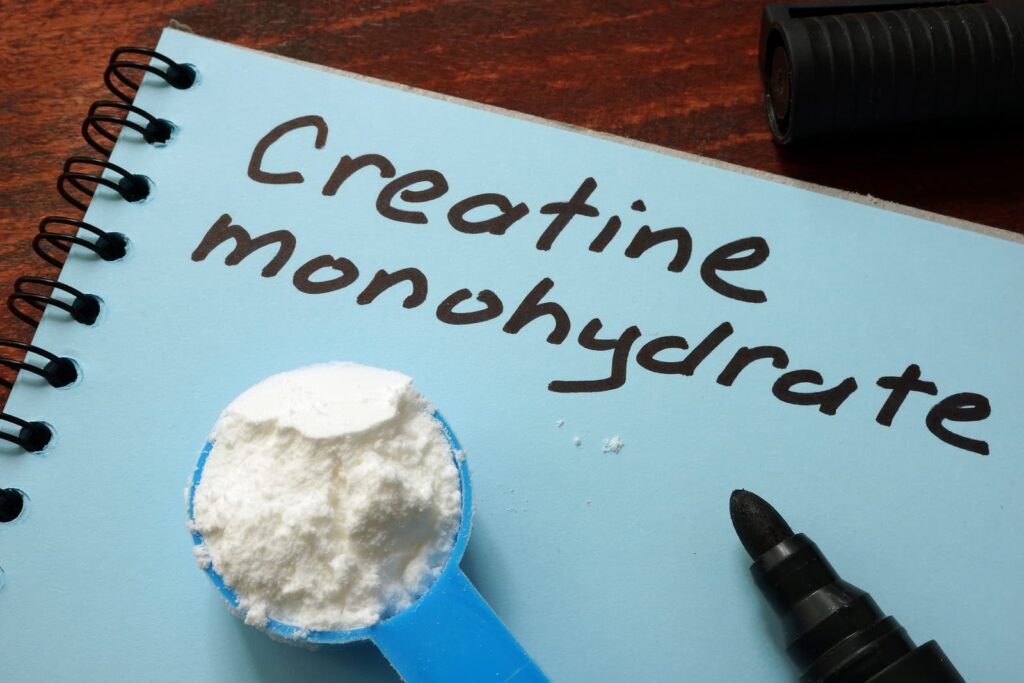
If you regularly go to the gym, you’ve probably heard the claim that creatine can cause hair loss. It’s a particularly common concern among men who are already noticing a receding hairline or thinning crown.
The theory sounds plausible at first: creatine may affect hormones, male pattern baldness is linked to hormones, so could taking creatine make hair loss worse?
You will be pleased to learn that the evidence doesn’t currently support this claim. In fact, a recent randomised controlled trial specifically investigated whether creatine affects DHT and hair health, and found no evidence that it causes hair loss.
Why is creatine linked to hair loss?
The concern largely comes from a small 2009 study involving university rugby players. Participants took a relatively high dose of creatine initially, followed by a lower maintenance dose. Researchers observed an increase in DHT levels during the study.
DHT, or dihydrotestosterone, is important because it plays a major role in male pattern baldness. In genetically susceptible men, DHT can cause hair follicles to gradually shrink, producing finer and shorter hairs over time.
This led to the theory that if creatine increased DHT, it might potentially accelerate male pattern hair loss. However, there’s an important problem with this argument: an increase in a hormone isn’t the same thing as demonstrating that a treatment causes hair loss.
The original study didn’t actually show that participants lost hair.
What does the latest research say?
We now have more direct evidence. A 2025 randomised controlled trial examined 45 resistance-trained men aged 18 to 40. Participants received either 5g of creatine monohydrate or a placebo every day for 12 weeks.
Researchers measured testosterone, DHT and several indicators of hair follicle health. The results were reassuring. There were no significant differences between the creatine and placebo groups in DHT levels or hair-related measurements.
Researchers also found no significant differences in hair density, follicular unit count or cumulative hair thickness. The study concluded that its findings provided strong evidence against the claim that creatine supplementation contributes to hair loss.
What if you already have thinning hair?
This is where the distinction between creatine and male pattern baldness becomes important. If you’re genetically susceptible to male pattern hair loss, your hair follicles may be sensitive to DHT.
The condition can gradually cause a receding hairline, thinning at the crown or general reduction in hair density. Creatine isn’t considered one of the established causes of this process.
So if you start taking creatine and happen to notice your hair becoming thinner, it doesn’t necessarily mean the supplement caused it.
Male pattern baldness is progressive, so changes in hair density can become noticeable around the same time that someone starts going to the gym or taking supplements.
Other factors, including stress, illness, nutritional problems and genetics, can also contribute to changes in hair growth.
Should you stop taking creatine if you’re worried about hair loss?
There’s currently no strong evidence that men need to stop taking creatine specifically to protect their hair. Creatine is widely used as a sports supplement and has substantial research supporting its role in exercise performance and muscle development.
If you’re concerned about your hair, however, it’s better to investigate the actual cause rather than automatically blaming a supplement.
Take photographs of your hairline and crown periodically under similar lighting. This can make gradual changes easier to identify than relying on what you see in the mirror from day to day.
If thinning is becoming progressively more noticeable, consider speaking to a healthcare professional about whether you’re experiencing male pattern baldness.
What about finasteride and creatine?
Finasteride is a prescription treatment for male pattern hair loss. It works differently from creatine: rather than being a sports supplement, it targets one of the hormonal pathways involved in male pattern baldness by reducing the conversion of testosterone into DHT.
If you’re taking or considering finasteride (the cheap unbranded version of Propecia), your healthcare provider can advise whether it is appropriate for you and discuss any potential risks and side effects.
Importantly, the question of whether creatine causes hair loss shouldn’t be confused with the question of whether finasteride is an effective treatment for male pattern baldness. They address entirely different issues.
For men concerned about a receding hairline or thinning crown, understanding what’s actually causing the hair loss is a much better starting point than giving up a supplement based on an unproven association.